


Eight days of month-end,done before the coffee.
How an Ayurvedic and wellness manufacturer took ecommerce GST reconciliation off spreadsheets - marketplace files from Amazon, Flipkart and others normalised into one structure, tax and classification rules applied automatically, and the GST working sheets and SAP upload datasets generated rather than assembled by hand.
The situation
Ecommerce grew into a serious sales channel, and month-end grew with it. Every marketplace sent its own monthly files - sales, B2B and B2C transactions, returns, cancellations, GST fields - and no two platforms structured them the same way. Before any of it could be filed or posted, the finance team had to download, clean, validate and consolidate thousands of rows by hand.
What followed was not data entry but judgement, repeated thousands of times. Which transactions are B2B and which B2C. Which are sales, which returns, which cancellations. Which are interstate and which intrastate. What GST applies, and how it splits into IGST, CGST and SGST. Which belong to Gujarat and which do not. Then the SAP sales and return datasets, in the exact structure SAP would accept, with the sequencing it expects.
The harder problem was where that judgement lived. One experienced colleague held all of it - the file structures, the transformations, the tax treatment, the state rules, the SAP formats, the exceptions. The process ran because they were there. If they were not there at month-end, GST reporting and SAP posting could wait.
The process was not written down anywhere. It ran because one person was there at month-end.
What we built
We started with the process rather than the screens. Working with the people who did the reconciliation, we mapped how each marketplace’s file was read, how B2B and B2C were told apart, how sales and returns were treated differently, how GST was calculated and split by state, what was checked by eye before anything was trusted, and exactly what each department needed at the end. The goal was to get the reasoning out of one person’s head and into rules a system could apply the same way every time.
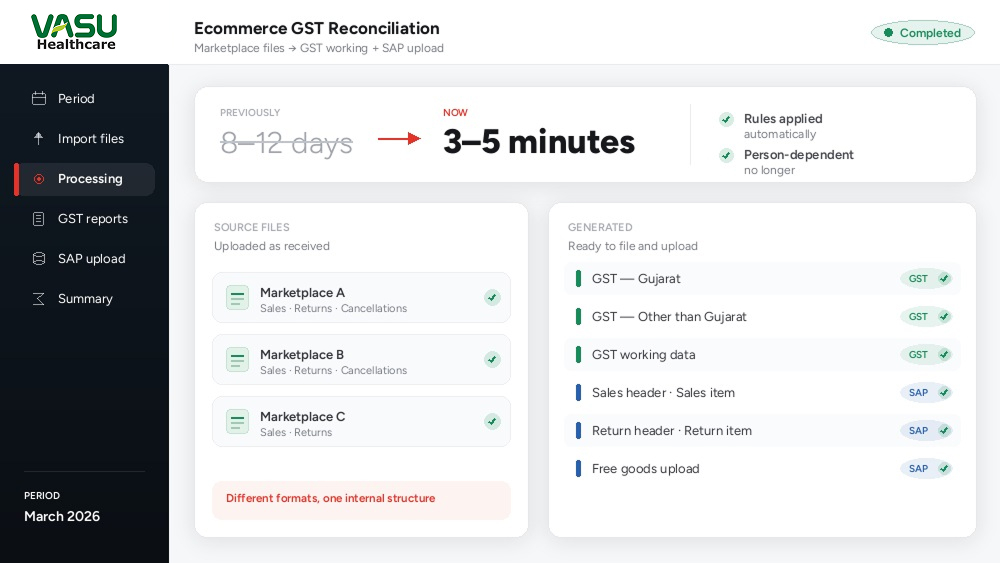
The result is a central application for ecommerce GST reconciliation and SAP data preparation. A user picks the reporting period and uploads the marketplace files exactly as they arrive - no reshaping first. The application normalises those different formats into one internal structure, then applies the configured rules: transaction type, B2B or B2C, sales, return or cancellation treatment, state classification, GST applicability, the IGST or CGST/SGST split, and the Gujarat and other-than-Gujarat separation. From there it prepares transaction-level GST working data and the SAP datasets, header and item, with the required sequencing, and generates the reports the finance team takes forward.
Inside the system
Raw marketplace files in, filed and postable datasets out, with the rules held in the system rather than in a person.
Processing
- Period-based control, so every run is traceable to its month
- Bulk upload of raw marketplace files, in the format they arrive in
- Normalisation of differing platform formats into one structure
- Configurable rules for transaction type, B2B/B2C, sales and returns
- State classification with IGST, CGST and SGST treatment
- Gujarat and other-than-Gujarat handled as separate streams
Outputs
- GST reports and working data, Gujarat and other-than-Gujarat
- GST summaries per ecommerce stream
- SAP sales header and item datasets
- SAP return header and item datasets
- Period-wise SAP upload dataset and free-goods upload report
- Final sales summary and period reconciliation data
What changed
The timings below are the client’s own, from their own case study. We have not measured them independently and have not added any figures of our own.
Month-end went from 8–12 days to 3–5 minutes
The client reports that a reconciliation which took approximately eight to twelve working days now completes in approximately three to five minutes once the source files are uploaded. It stopped being the shape of their month-end.
The process stopped depending on one person
GST rules, file mappings, transaction treatments and SAP preparation now sit in the application rather than in one colleague’s Excel practice. What was individual knowledge became something the organisation owns and anyone on the team can run.
The same rules applied to every transaction
B2B and B2C treatment, Gujarat against other states, interstate against intrastate, IGST, CGST and SGST, returns and cancellations - applied identically across thousands of rows instead of being decided case by case in a spreadsheet.
Work that can be traced back
Imported, processed, rules applied, reports generated - a transaction can be followed from the file it arrived in through to the output it ended up in, which a set of separately edited spreadsheets could never show.
How it was built
A processing layer between the marketplace files and the systems that already run the business - the ecommerce platforms, GST filing and SAP were all left as they were.
Other systems we have built near this one
 Pharma & Life SciencesCertificates of Analysis, from Excel to a controlled workflowRead the case study>
 Pharma & Life SciencesSAP access and change requests, from ask to go-liveRead the case study>
 Pharma & Life SciencesA Kaizen system tracking employee ideas from submission to rewardRead the case study>
Which of your month-end tasks runs on one person and a spreadsheet?
GST reconciliation, marketplace settlements, ERP upload preparation - anywhere the rules live in someone’s head and the work lives in Excel. Tell us how yours runs today and we will tell you honestly which parts could be turned into rules and which could not.