



Hours that belong toreal work, every week.
How a process engineering firm runs assigned project work, weekly timesheets and approvals, and the company intranet beside them, from one role-based system whose hours feed project, department and billability reports.

The situation
A process engineering firm runs many live jobs at once. Hours are split across clients, departments and tasks, and the same week has to be filled by the engineer, seen by a manager, and later counted for the project.
Spreadsheets made that path fragile: who is assigned, which task is billable, which week is still a draft, and how many hours a project has already used. Quanta Process needed one intranet for that work, and for the company information that sits beside it.
Which task is billable, which week is still a draft, and how many hours a project has already used.
What we built
We treated the project and the week as the two units of work. A project holds the client, departments, tasks and hour budget. A timesheet holds one employee’s week, and people can log time only against project tasks they are assigned to, so every hour in a report belongs to a real job.
Submitting a week locks it and writes a status history, so a later approval or rejection never overwrites the path. The same hours then feed project, employee, department and billability reports, each with a date filter and Excel export.
Inside the intranet
One employee’s week, from assignment to the report.
Projects and assignment
- Clients, departments and a task master
- Projects with allocated hours by department
- Employees assigned to project tasks
- Project grid or list views with status
Weekly timesheets
- Monday to Sunday entry against assigned tasks
- Time off for company holidays and annual leave on the same sheet
- Save as draft or submit, with submission locking the week
- Approve or reject, with a status history for every change
Reports and company life
- Project hours, employee, department and billability reports
- Pending-timesheet reminders and submission notifications
- News, events, HR documents, quick links and holidays
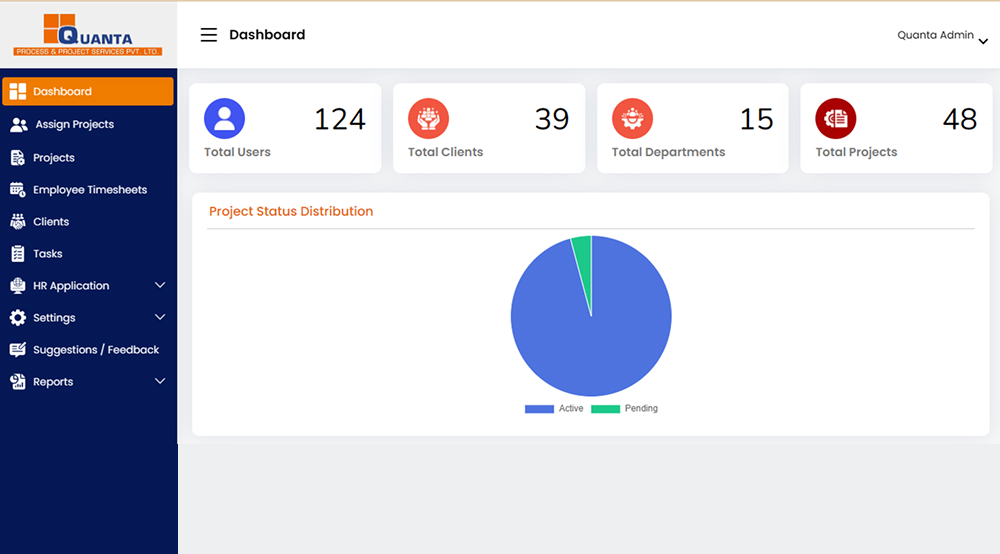
- Role-based dashboards for admins, managers and employees
What it looks like
Screens from the staging environment, populated with test data.
What changed
Hours belong to real work
A timesheet offers only the projects an employee is assigned to, so the hours that reach a report already sit against a live job.
Budgets visible on the project
Used and pending hours sit beside each project’s department allocations, so progress is read from the system rather than a separate spreadsheet.
Billable time separated from the rest
Billability on each task, and the overhead and business development flags on projects, let reports separate chargeable work from everything else.
How it was built
A web application with role-based screens, so an employee sees their own timesheets and the HR pages while administration and reports stay with the roles that own them.
Other systems we have built near this one

Is your team still filling timesheets in a spreadsheet?
Tell us how projects, hours and billability reach your management today. We will tell you honestly what an intranet would change, and what it would not.